
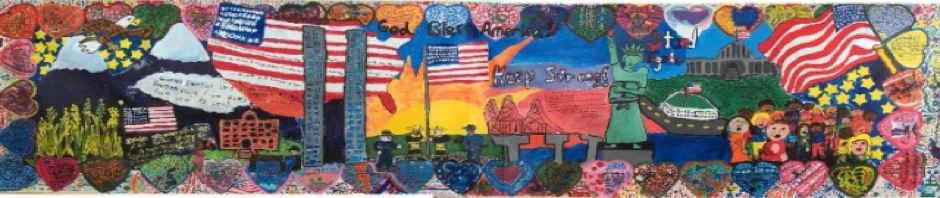
It was September 11, 2001. Four of us advertising gals were in Playa del Carmen, in Mexico, celebrating our friend’s 50th birthday when the terrorists attacked. I’ll never forget that morning.
The early riser, I slipped into my clothes and quietly tiptoed out of our little casita in search for a hot cup of caffeine. I was alone that morning, the only guest moving about. As I approached the circle of tables where breakfast was normally served, I caught sight of four or five uniformed waiters all huddled around a tiny, rusted TV set perched atop a wooden stool. When one of them saw me approaching he stepped toward me quickly and beckoned me in his broken English, “Americano?” He took my arm and pulled me into the group circling the TV. I was a bit taken aback by his boldness.
“Something bad in your country,” he continued with a fervor in his voice.
I leaned in and watched as dark black smoke billowed, swallowing the top of a tall shiny skyscraper. “Neuvo York,” one of the men interjected. As I watched in horror, the screen switched to an anchorman who explained that two planes had flown into the Twin Towers. “A terror attack,” he announced.
After absorbing the enormity of the news, I returned to our rooms and woke my friends. The four of us tried to make sense of what had happened over a quick breakfast, then decided to leave Playa del Carmen early. We booked seats on a local bus to Cancún, believing it would be wiser to stay near the airport and U.S. Embassy. Once there, we found a room at either a Hilton or a Hyatt—I no longer remember which—where we would remain for the next few days.
I’ll never forget that overwhelming sense of desperation—an almost primal instinct to reach my children and protect them. My husband Jim assured me they were okay but I continued to beg, even bargain with God to get me home so I could see them, hold them and protect them from this nightmare that I feared would scar them for life.
Within the day the ATMs shut down, our credit cards quit working, phone lines to the US embassy remained flooded, and calls home no longer went through. I remember gathering by the pool with other stranded American tourists. The waiters offered us food and drinks, but all we wanted was to find a way to get home.
The next morning, we packed our bags, traveled to the airport, and like refugees, we sat on the floor for hours alongside hundreds of other desperate travelers. We waited and hoped that a plane—any plane—would be allowed to leave Mexico and land in the United States.
Every rental car was taken. No bus seats were available. We tried everything. My husband even contacted a friend who was an international private pilot, but that led nowhere. American airspace was locked down tight.
After two days, with no hope of securing seats on a U.S.-bound flight, a small group of us decided to buy tickets on a Mexican airline flying to Monterrey, the closest major city to the border. If we could just get close, we reasoned, we could find bicycles or even walk across the border if we had to.
Among our small group was a frightened young honeymooning couple who had run out of money. Though we weren’t sure how, we promised to take care of them and convinced them to come with us.
Once in Monterrey we deplaned and walked into the airport terminal. Unsure of what next, we heard a gate agent yelling at us, “We have a small plane leaving for Houston in 10 minutes. They have a few open seats. Run. Run as fast as you can.”
To this day I have no idea if the small plane we boarded was a private one or commercial – we were never asked to pay a dime. All I remember is how deadly silent the flight was. No one said a word, not a single word.
We arrived in Houston in middle of the night. Our little group followed a uniformed woman who led us silently through the dark, empty, cavernous halls of the concourse. The stillness still haunts me. We were then herded onto a small bus that took us to local hotels designated for those stranded. Each of us was given a piece of paper with a room number and instructions for the next day’s shuttle and flight instructions. They dropped me off at a Days Inn where I was greeted with a key, a sack dinner and a bottle of water. I never saw my friends again, nor the sweet young couple.
The next morning I floated through the instructions I was given. I showered, packed up, then checked out of my hotel. I boarded the shuttle bus and rode to the airport in a totally different level of consciousness. Once on my plane, I sat in total silence throughout my 2-hour flight to Atlanta. We landed then I walked through the morgue-like halls of the Atlanta airport. Like a robot, I gathered my luggage then boarded the empty subway train that would take me to the stop closest to my home. Once there I gave my address to a cab driver and, as he drove through the streets of my neighborhood, I remember seeing hundreds of tiny little flags stuck in my neighbors’ lawns. I closed my eyes and said a tiny prayer. I was finally home, thank God, home on American soil.
It wasn’t until twenty years later that I finally found some answers. I was riding a shuttle from Auburn, Alabama, to the Atlanta airport when a fellow passenger mentioned that he worked for Homeland Security and was on his way to Washington, D.C.
“I had the most unusual experience during 9/11,” I told him, taking the opportunity to share my story. He listened carefully, and when I explained that I had never learned who arranged and paid for our flights and hotel, he smiled.
“Your government did,” he said.
I will always be grateful to be an American.
——————————
For this reason I feel drawn to Ground Zero. My son and I visited the site just three months after the bombing. The outpouring from around the nation and world made a huge impact on both of us. Banners, flowers, teddy bears, letters, poems, even a singed courier’s bike . . . memorials of all types lined the area.
What followed 9/11 is one of the greatest example of the human spirit, possibly the greatest in our lifetime. To quote Rudolph W. Giuliani: “The attacks of September 11th were intended to break our spirit. Instead we have emerged stronger and more unified. We feel renewed devotion to the principles of political, economic and religious freedom, the rule of law and respect for human life. We are more determined than ever to live our lives in freedom.”
—————————— continued from September 2011 walk:
My childhood friend, Debbie, was in town for the weekend. Being her first time in NY, she had only one request – that we visit Ground Zero.
 Unfortunately we are just a few months short of the opening of the 9/11 Memorial, slated to open on the tenth anniversary of the attacks. We visited the temporary memorial center at 120 Liberty Street near Ground Zero and another memorial at St. Paul’s Chapel. I urge you to visit St. Paul’s and if you have time, the temporary memorial.
St. Paul’s Chapel
209 Broadway at Fulton Street, in Lower Manhattan near Wall Street

“For more than a year after the World Trade Center attacks, the chapel’s fence served as a shrine for visitors seeking solace. People from around the world left tokens of grief and support, or signed one of the large drop cloths that hung from the fence. After having served as a 24-hour refuge where rescue and recovery workers could eat, pray, rest, and receive counseling, the chapel, which amazingly suffered no damage, reopened to the public in fall 2002. The powerful ongoing exhibit, titled Unwavering Spirit: Hope & Healing at Ground Zero, honors the efforts of rescue workers in the months after September 11 with photos, drawings, banners, and other items sent to them or as memorials. Open since 1766, St. Paul’s is the oldest public building in continuous use in Manhattan.”
Tribute WTC Visitor Center
Located at 120 Liberty Street, the former Liberty Deli site, across from Ground Zero
“In the aftermath of 9/11, the deli became a station where meals were served to rescuers often by celebrities who came to volunteer and give the tired workers a boost. Later, the deli became a distribution point for equipment like gloves, socks, respirators, eye drops and tools.
“Daily walking tours are conducted along the World Trade Center site and are led by people whose lives were profoundly changed by September 11th. Each tour is unique and connects those who want to hear stories with those who want to share them.”
One Response